
Table of Contents
- Why American Made Disposable Face Masks Matter for Business Procurement
- What to Compare When Buying Bulk Face Masks for Business
- How to Verify Mask Country of Origin Before You Commit
- ASTM Level 1 Face Masks and Other Standards Explained
- USA-Made N95 Masks: What Procurement Teams Should Know
- Common Mistakes When Sourcing American Made Disposable Face Masks
- Frequently Asked Questions
Last Updated: October 9, 2026
Why American Made Disposable Face Masks Matter for Business Procurement
American made disposable face masks have become a procurement priority for U.S. businesses burned by overseas supply chain failures.

That experience reshaped how procurement teams evaluate suppliers. Domestic production means shorter lead times, clearer accountability, and materials traceable to a known source.
Below, we break down what to compare, how to verify origin claims, and where ASTM ratings actually apply.
What to Compare When Buying Bulk Face Masks for Business
Bulk face masks for business come down to two things: what the mask is made of and how it's packaged.
Construction and Filtration Layers
A standard 3-ply mask uses three layers: an outer layer that repels droplets, a middle melt-blown layer that filters particles, and a soft inner layer. Melt-blown polypropylene matters most for filtration, and its quality varies widely.
Ask what the middle layer is made of and where it was produced. Thin or inconsistent melt-blown layers feel flimsy and filter poorly; heavier, well-bonded layers hold their shape through a full shift.
Packaging and Volume Pricing
Packaging decides how usable a case is on your floor. Individually wrapped masks stay clean until needed, which matters in food processing, clinics, and shared workspaces. Loose masks in a dispenser box degrade fast in humid environments.
Volume pricing should scale predictably from cases to pallets. Ask for a written quote at each tier and confirm whether recurring orders lock in the same rate.
| What to Compare | Why It Matters | What to Ask For |
|---|---|---|
| Middle layer material | Drives filtration quality | Melt-blown spec and origin |
| Packaging format | Hygiene and shelf life | Individually wrapped vs. loose |
| Volume tiers | Total cost at scale | Written quote per tier |
| Lead time | Keeps operations running | Committed delivery window |
How to Verify Mask Country of Origin Before You Commit
Verifying mask country of origin means checking documentation, not reading the box. Counterfeit and mislabeled masks are a real problem, and a printed flag proves nothing.
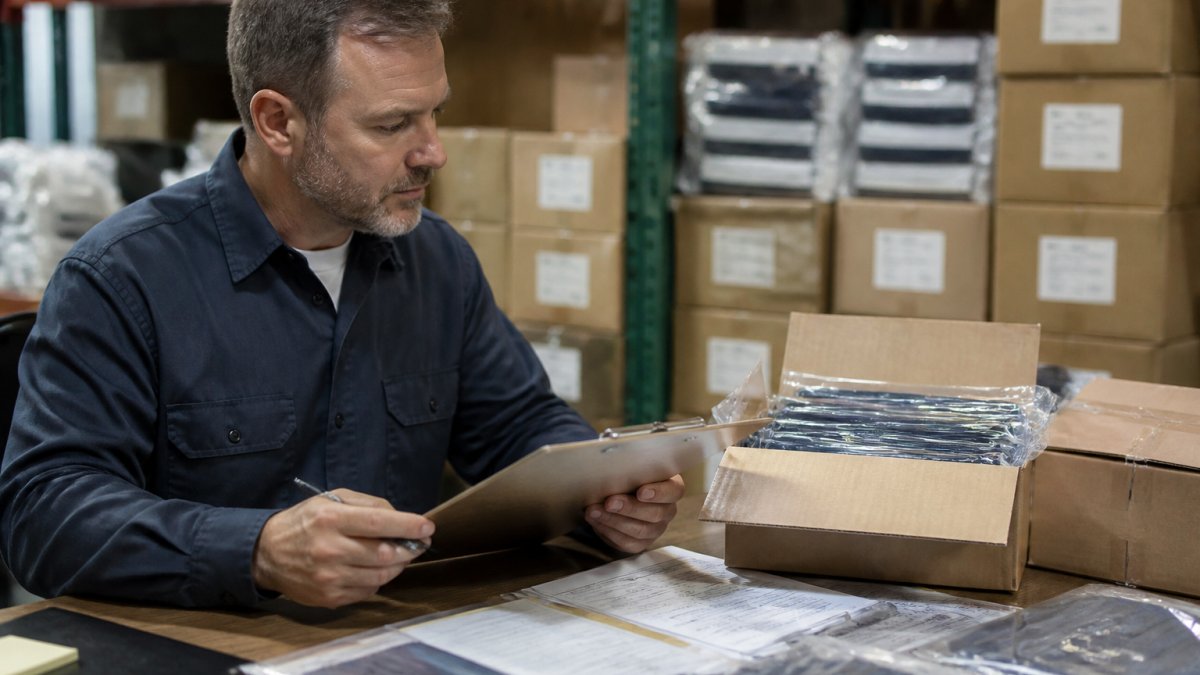
Request the manufacturer's address and a sample of the actual packaging before a large order. If the supplier hesitates or sends marketing material instead of documents, treat that as a warning sign.
The Documents That Actually Prove Origin
A legitimate domestic supplier can produce most of the following on request. You should get at least the first three without pushback:
- Producing facility name and full street address, not a P.O. box, not a corporate headquarters, the actual plant.
- Raw material origin documentation, where the melt-blown polypropylene and the outer/inner layers were made. A mask can be assembled domestically from imported fabric, and that distinction matters for some compliance files.
- A sample of the retail and case packaging, so you can compare what you were promised against what actually ships.
For masks marketed as medical devices, ask for the FDA establishment registration and device listing for the producing facility. The FDA does not certify masks, it clears them, but cleared medical masks appear in the FDA's public databases, and a supplier who points you to their listing has nothing to hide.
Counterfeit and Mislabeled Mask Red Flags
A printed "Made in USA" claim is not regulated the way most buyers assume. The FTC polices domestic-origin claims, and an unqualified label legally means all or virtually all of the product was made in the country (the FTC). Mislabeled imports still reach the market. Watch for these patterns:
- Vague facility language. "Made in USA" with no plant name, no city, no state. A real domestic producer will name the plant.
- Packaging that changes between orders. Different fonts, different flag graphics, different lot-number formats. Counterfeiters rarely keep packaging consistent.
- No lot or batch number. Legitimate manufacturers track production lots. If your case has no lot code, you have no traceability.
- Prices that undercut every domestic competitor by a wide margin. Domestic labor and materials cost more. A price that looks too good usually is.
Documentation and Supply Chain Transparency
Ask for the name and location of the producing facility, plus the source of raw materials. A legitimate domestic supplier will tell you exactly where production happens.
Forbes Medical PPE, for example, produces its masks in partnership with Peoria Production Solutions in Peoria, Illinois, and says so in writing. That specificity separates a real domestic supplier from a repackager.
A Quick Verification Workflow
For a repeatable process, run every new supplier through this sequence before the first purchase order:
- Request the producing facility name and street address in writing.
- Request raw material origin for the melt-blown layer.
- Request a sample case and inspect the packaging against the marketing materials.
- Verify any FDA clearance or NIOSH approval claims against the relevant public database.
- Confirm lead times and a named contact in writing.
- Run a pilot order through your actual storage conditions before scaling.
Suppliers who pass all six steps are worth a long-term relationship. Suppliers who stall on step one are not.
ASTM Level 1 Face Masks and Other Standards Explained
ASTM Level 1 face masks meet the lowest of three barrier performance tiers set by ASTM International for medical face masks. The standard, ASTM F2100, rates how well a finished mask resists splashes, droplets, and particulate filtration under lab conditions.
Here's what most buyers get wrong: ASTM ratings apply to masks intended for medical use, and a mask only carries a rating if the finished product was tested as a whole.
Black 3-Ply Face Masks Individually Wrapped and Disposable 200 per Case →
What the Three Levels Actually Measure
The F2100 standard tests five things: bacterial filtration efficiency (BFE), particulate filtration efficiency (PFE), differential pressure, fluid resistance, and flammability. The levels differ mainly on fluid resistance and filtration thresholds:
| Property | Level 1 | Level 2 | Level 3 |
|---|---|---|---|
| BFE (bacterial filtration) | ≥ 95% | ≥ 98% | ≥ 98% |
| PFE (particle filtration) | ≥ 95% | ≥ 98% | ≥ 98% |
| Fluid resistance | 80 mmHg | 120 mmHg | 160 mmHg |
| Differential pressure | < 5.0 mm H₂O/cm² | < 6.0 mm H₂O/cm² | < 6.0 mm H₂O/cm² |
| Flammability | Class 1 | Class 1 | Class 1 |
Those mmHg numbers matter most in practice: they represent how much pressure a synthetic blood splash can exert before penetrating the mask. Level 1 handles a light, low-pressure splash; Level 3 handles arterial spray and high-pressure irrigation, surgical exposure, not warehouse exposure.
Matching the Level to the Setting
A simple rule: match the level to the worst realistic splash your wearer will face, not the average.
- Level 1, routine exams, dental cleanings, food processing, general workplace use where splashes are incidental and low-pressure.
- Level 2, blood draws, suturing, lab work, and any setting where a moderate fluid splash is plausible.
- Level 3, surgery, trauma, high-pressure irrigation, and any procedure where arterial or high-velocity spray is possible.
For general workplace use, a well-made 3-ply barrier mask does the job without an ASTM rating. The key is honest labeling, a supplier claiming an ASTM rating on an untested mask is telling you something about how they operate.
A Note on Color and FDA Clearance
One detail that trips up buyers: black and red masks will not pass the blood splatter detection test needed for FDA clearance, no matter how effective the mask actually is. The test relies on visual detection of synthetic blood, and dark dyes obscure the result. A black mask can be a perfectly good barrier mask for industrial and commercial use, but it cannot carry FDA clearance as a medical face mask.
USA-Made N95 Masks: What Procurement Teams Should Know
USA-made N95 masks are respirators, not barrier masks, and follow a different approval path.
That approval is specific to the respirator model, not the brand. If a supplier claims NIOSH approval, ask for the approval number and verify it against the NIOSH Certified Equipment List.
Fit matters as much as filtration for N95s. A respirator only performs as rated when it seals properly, which is why workplaces with respiratory hazards run fit testing.
For most general workplace settings, an N95 is more protection than the task requires. Save respirators for genuine airborne particulate hazards and use barrier masks everywhere else.
Common Mistakes When Sourcing American Made Disposable Face Masks
The biggest mistake in sourcing American made disposable face masks is treating price as the only variable. A cheaper case that arrives late, fails inspection, or sits unusable in humidity costs more than the savings return.
Here are the pitfalls we see most often:
- Skipping the sample order. Always test a case in your actual environment before committing to pallet quantities.
- Accepting verbal origin claims. Get the producing facility's name in writing.
- Ignoring storage conditions. Individually wrapped masks hold up far better in humid plants and temperature swings.
- Forgetting the compliance file. Your safety officer needs documentation before an audit, not after.
A practical supplier checklist:
- Producing facility name and address provided in writing
- Raw material origin documented
- Sample case tested in your actual environment
- Volume pricing quoted per tier
For a straightforward domestic option, our Black 3-Ply Face Masks are made in partnership with Peoria Production Solutions in Peoria, Illinois, using the same high-quality line and ASTM-certified melt-blown material as our medical masks.
Frequently Asked Questions
What should businesses compare when buying disposable masks in bulk?
Focus on four factors: construction layers (3-ply with meltblown middle layer provides better filtration), packaging format (individually wrapped masks stay clean and are easier to distribute), supply consistency (can the manufacturer scale to pallet quantities during peak demand), and total cost per mask at your volume. Request samples before committing to large orders, and confirm the manufacturer can provide documentation of domestic production if that matters for your compliance requirements.
How can I verify where a disposable face mask is made?
Ask the supplier for documentation linking the product to a specific domestic manufacturing facility. Legitimate American made masks should have packaging that names the production location, and suppliers should be able to provide facility information or third-party verification. Be cautious of vague claims like 'designed in the USA' or 'USA-based company' that do not confirm where the masks are actually manufactured. Request a sample order first and inspect the packaging for specific facility details.
Are ASTM ratings required for all disposable face masks?
No. ASTM ratings apply to medical and surgical masks tested as a complete unit. Barrier-style masks used for general workplace protection, dust, and hygiene are not required to carry ASTM certification. If your facility needs masks for non-medical use such as manufacturing, food processing, or general workplace hygiene, a well-constructed 3-layer barrier mask without ASTM rating can be appropriate. Check your specific industry requirements to determine whether ASTM-rated products are necessary for your compliance needs.
What is the difference between a barrier-style mask and a surgical mask?
Surgical masks are FDA-cleared medical devices that must pass specific fluid resistance and filtration tests as a complete unit. Barrier-style masks use similar materials and construction but are not intended for medical use and do not carry FDA clearance or ASTM ratings. For industrial, commercial, and general workplace settings, a barrier-style mask with 3-layer construction provides reliable protection against dust, debris, and respiratory droplets. Surgical masks are required in clinical settings where fluid resistance and medical-grade filtration are mandated.
Every procurement team eventually faces the same test: a supplier who can't deliver when it counts. Forbes Medical PPE exists to pass that test, with domestically produced masks, individually wrapped for freshness, volume pricing for pallet quantities, and a supply chain you can actually verify. Contact us for distributor pricing or recurring business orders, and get a domestic mask supply your compliance officer can stand behind.