
Last Updated: October 25, 2026
Quick Summary
There is no such thing as ASTM certification for industrial masks. ASTM International publishes test standards like ASTM F2100 but does not certify, approve, or clear any mask, so buyers should request the full laboratory test report instead of a certificate.
- ASTM F2100 sets minimum criteria across five test areas: BFE, PFE, fluid resistance, differential pressure, and flammability.
- Fluid resistance thresholds are 80 mmHg at Level 1, 120 mmHg at Level 2, and 160 mmHg at Level 3.
- Match the ASTM level to your actual exposure profile rather than buying Level 3 for everything.
- ASTM F2100 covers barrier face masks, not respiratory protection; NIOSH governs respirators.
- Verify claims by requesting the full test report, matching it to the product, and checking labeling.
Table of Contents
- What ASTM Certification Requirements for Industrial Masks Actually Mean
- ASTM F2100 Mask Requirements: The Five Tests Behind Every Rating
- ASTM Mask Levels 1, 2, and 3: What Changes Between Them
- ASTM Mask Certification vs. Testing: What a Report Does and Does Not Prove
- How to Verify ASTM Mask Claims Before You Sign a Purchase Order
- Industrial Masks vs. Respirators: Where ASTM Stops and NIOSH Begins
- Building Your Mask Specification: A Selection Framework for Buyers
- Request Documentation and Volume Pricing From Forbes Medical PPE
- Frequently Asked Questions
What ASTM Certification Requirements for Industrial Masks Actually Mean
Here is the uncomfortable truth about ASTM certification requirements for industrial masks: there is no such thing as "ASTM certification." ASTM International publishes test standards.
At Forbes Medical PPE, we build masks on a line that uses ASTM-rated meltblown filtration media, so we have a working familiarity with what these standards measure and, just as importantly, what they don't.
ASTM F2100 is a specification standard for barrier face masks used in healthcare settings. It defines minimum performance criteria across five test areas: bacterial filtration efficiency, particulate filtration efficiency, fluid resistance, differential pressure (breathability), and flammability (F2100 Standard Specification for Performance of Materials Used in Medical Face Masks). A mask that meets a given level has been tested to those criteria. It has not been "certified" by ASTM, and no certificate exists to hang on a wall.
The practical consequence: when a supplier says "ASTM certified," ask which laboratory ran which test, to which edition of the standard, and request the report. That single question separates serious suppliers from repackagers.
ASTM F2100 Mask Requirements: The Five Tests Behind Every Rating
ASTM F2100 mask requirements come down to five laboratory tests, and every performance claim on a mask box traces back to one of them. The standard sets minimum acceptance criteria for each test at each of the three levels. Understanding the test method, the unit of measure, and the threshold tells you what the rating does and does not promise.
Filtration: BFE and PFE
Bacterial filtration efficiency (BFE) measures how well the mask filters out bacteria-sized particles, expressed as a percentage. The test method is ASTM F2101, which challenges the mask material with a aerosol of Staphylococcus aureus and measures the fraction that passes through (F2101 Standard Test Method for Evaluating the Bacterial Filtration Efficiency (BFE) of...). Particulate filtration efficiency (PFE) does the same with 0.1-micron latex particles under ASTM F2299, the fine aerosol range that matters most for airborne exposure.
Fluid Resistance
Fluid resistance is tested under ASTM F1862 by directing a stream of synthetic blood at the mask at a specified velocity and pressure, measured in mmHg. The standard defines three pressure thresholds that correspond to the three levels: 80 mmHg at Level 1, 120 mmHg at Level 2, and 160 mmHg at Level 3. The test matters because blood and bodily fluids can carry pathogens, and a mask that wicks under a splash offers no barrier protection at the moment it is needed most.
Differential Pressure (Breathability)
Differential pressure measures breathability: the resistance to airflow across the mask material, reported in mm H2O/cm². Lower pressure means easier breathing. The standard caps differential pressure at each level so that a higher fluid barrier cannot be achieved by making a mask unwearable. This is the spec buyers overlook most often. A mask with excellent filtration and poor breathability gets pulled down or worn incorrectly, which defeats the purpose.
Flammability
Flammability testing under 16 CFR Part 1610 confirms the mask material resists ignition within defined limits. It is a straightforward safety check, and it is rarely the failing point. A mask that fails flammability is a materials problem, not a filtration problem.
Biocompatibility
Biocompatibility is the one most suppliers cannot document well. The standard calls for evaluation of skin sensitivity and cytotoxicity, meaning the materials should not irritate skin or harm cells on contact. For teams wearing masks through full shifts, this is not a formality. It is the difference between a mask people keep on and one they fight all day.
ASTM Mask Levels 1, 2, and 3: What Changes Between Them
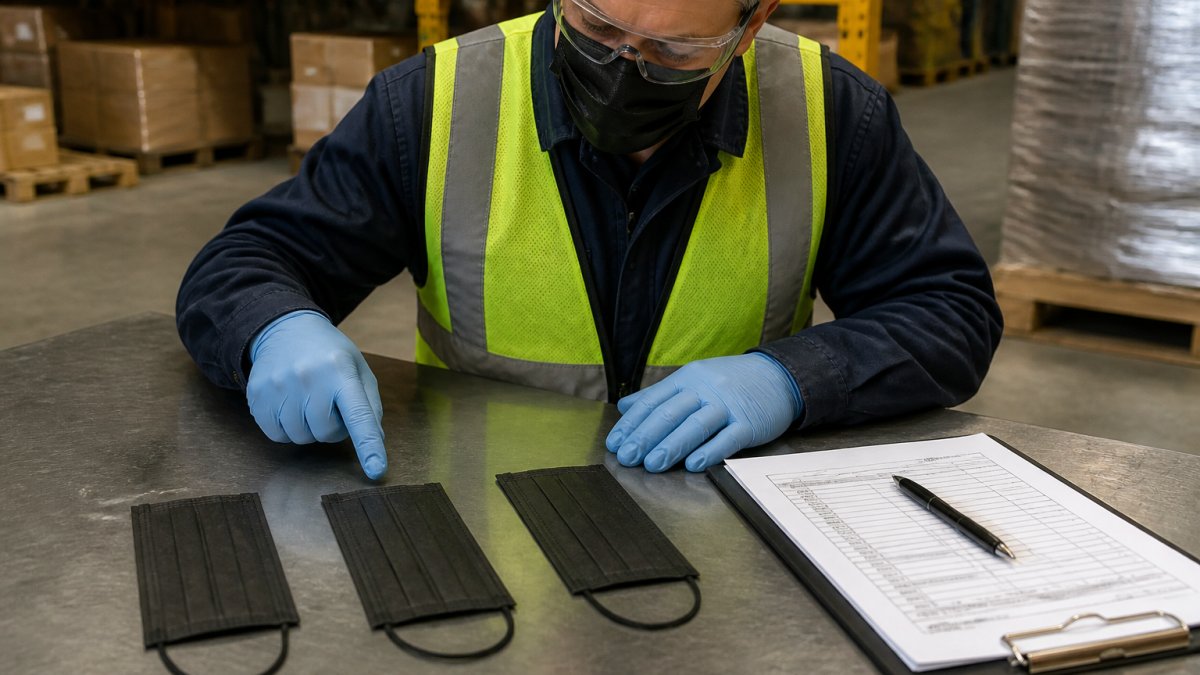
The three ASTM mask levels map to risk exposure, not to quality tiers. A Level 1 mask is not a "worse" Level 3. It is built for a lower fluid-exposure scenario, and it will usually breathe easier as a result. The levels differ mainly in the fluid-resistance threshold they must meet, with filtration and breathability floors set across all three.
| Level | Typical Use Setting | Fluid Resistance (ASTM F1862) | Filtration Floor | Breathability Cap |
|---|---|---|---|---|
| Level 1 | Low-risk, general use, short procedures | 80 mmHg | BFE and PFE at or above the standard minimum | Differential pressure at or below the Level 1 cap |
| Level 2 | Moderate risk, more fluid exposure | 120 mmHg | BFE and PFE at or above the standard minimum | Differential pressure at or below the Level 2 cap |
| Level 3 | High-risk, heavy splash or spray | 160 mmHg | BFE and PFE at or above the standard minimum | Differential pressure at or below the Level 3 cap |
What changes between levels is primarily the fluid resistance threshold and, in practice, the construction that achieves it. Higher fluid resistance generally means a tighter barrier, which can reduce breathability.
A common mistake is buying Level 3 for everything "to be safe." In a low-splash industrial or food-handling environment, that often produces a hotter, harder-to-breathe mask that staff remove when supervisors aren't looking. Match the level to the exposure, not to a vague sense of caution.
For industrial buyers, the practical rule is to start from the exposure profile in the work area, then pick the lowest level that meets it. That keeps breathability as high as the hazard allows and avoids over-specifying a mask that workers will not keep on.
ASTM Mask Certification vs. Testing: What a Report Does and Does Not Prove
A test report tells you that a sample submitted to a laboratory met stated criteria on a stated date, under a stated edition of the standard.
What a report also does not prove is regulatory status.
For industrial buyers, the honest framing is this: ASTM testing gives you a comparable performance benchmark. It is a tool for specification, not a stamp of approval.
How to Verify ASTM Mask Claims Before You Sign a Purchase Order
Verifying ASTM mask claims takes four steps, and none of them require a laboratory of your own. Ask, read, cross-check, and document.
- Request the full test report, not a summary line on a sell sheet. Confirm the laboratory name, the test dates, and the ASTM F2100 edition cited.
- Match the report to the product. The report should identify the specific model and construction, not a generic "3-ply mask."
- Check the labeling. Packaging should state the level claimed and the standard it references. Vague labeling is a red flag.
That last point comes up constantly with our own customers. Procurement officers ask how they can be sure a mask was actually made where the supplier says.
One more verification habit worth building: pull a sample from a received shipment and compare it physically to the sample you approved.
Industrial Masks vs. Respirators: Where ASTM Stops and NIOSH Begins
Industrial masks and respirators are governed by different systems, and confusing them creates real compliance exposure. ASTM F2100 covers barrier face masks.
This is where generic "industrial mask" marketing gets sloppy. A dust mask sold for comfort, splash protection, and general barrier use is one product category.
For non-medical barrier use in industrial, commercial, and workplace settings, an ASTM-tested mask can be a sensible choice.
Building Your Mask Specification: A Selection Framework for Buyers
A workable mask specification answers five questions in writing, and it should live in your procurement file, not in someone's memory. Use this framework:
- Exposure profile. What is the fluid, splash, or particulate exposure in the actual work area? Low, moderate, or high?
- Level target. Which ASTM level matches that exposure, and what is the breathability trade-off?
- Documentation requirement. Which reports, labeling, and origin records must the supplier provide before award?
- Packaging format. Bulk or individually wrapped? Individually wrapped masks protect freshness and hygiene in humid or temperature-variable facilities, which matters in food processing and warehousing.
- Volume and continuity. What quantity do you need at peak, and can the supplier document capacity to meet it?
That fifth question is the one that burns buyers. A supplier who can ship a sample pallet is not the same as a supplier who can ship fifty on schedule.
Forbes Medical PPE manufactures in Peoria, Illinois with domestically sourced materials and offers volume pricing and pallet quantities, so buyers who need a documented domestic supply chain have a direct path to evaluate.
That honesty is the point. Ask every supplier the same question and see who answers it the same way.
Request Documentation and Volume Pricing From Forbes Medical PPE
The gap between a supplier who says "ASTM certified" and one who can hand your compliance officer a complete documentation package is the gap between a risk and a resolved risk.
Forbes Medical PPE supplies individually wrapped, 3-layer masks manufactured in the USA with domestically sourced materials, in volume pricing and pallet quantities built for facilities that cannot afford a supply interruption.
Get started with Forbes Medical PPE and put a documented, domestically sourced mask supply behind your workplace safety program.
Frequently Asked Questions
Does ASTM certify masks?
No. ASTM writes and publishes the F2100 standard, but it does not certify, approve, or police masks. A manufacturer tests its masks against the standard and states the level it meets. The FDA clears medical masks for medical use; it does not certify them either. For industrial buyers, that means the rating on the box is a manufacturer claim backed by test reports, not a certificate issued by a standards body.
Are industrial masks required to meet ASTM standards?
No federal rule requires general industrial masks to meet ASTM F2100. The standard is voluntary unless a buyer, a contract, or a state workplace rule makes it mandatory. What is required depends on the hazard: if the task involves dusts, fumes, or other respiratory hazards, a NIOSH-certified respirator with fit testing is the relevant requirement, not ASTM. For splash and droplet barrier protection in non-medical settings, ASTM levels are a useful specification tool.
What is the difference between an ASTM-tested material and an ASTM-rated mask?
An ASTM-tested material means a component, such as the meltblown filter layer, was tested and met a performance threshold. An ASTM-rated mask means the finished mask was tested as a whole and meets all the F2100 requirements for its level. The distinction matters: a mask built from certified material can still fail as a finished product if construction, fit, or the outer layers fall short. Ask which one a supplier is actually claiming.
How can you verify a mask's ASTM rating?
Ask for the test report, not just the word ASTM on the box. Check that the report names the finished mask model, the test method, the measured result, and the date. Look for an ISO 17025-accredited lab if your compliance officer needs third-party evidence. Then confirm the packaging states the level and the standard edition, and that the model number matches your purchase order. A supplier who cannot produce that paperwork is asking you to take the rating on trust.
Do non-medical barrier masks need ASTM testing?
They are not required to be ASTM tested. A barrier mask sold for non-medical use can be a comfortable, durable breathing barrier without carrying an ASTM rating, because the full mask has not been tested as a whole. That is not a defect; it is a scope statement. If your workplace needs a documented fluid-resistance level, specify an ASTM-rated mask. If you need general barrier protection for clean, non-hazardous settings, an unrated barrier mask can be the practical choice.
What tests are used to evaluate ASTM mask performance?
ASTM F2100 covers five areas: bacterial filtration efficiency (BFE), particulate filtration efficiency (PFE) at 0.1-micron particles, fluid resistance measured by synthetic blood at increasing velocities, differential pressure for breathability, and flammability. Each test has an acceptance threshold tied to the level. A mask is rated at a level only when it passes all five at that level, so a strong BFE score alone does not earn a Level 3 label.
