
Table of Contents
- Why Domestically Sourced PPE Reduces Supply Chain Risk
- Supply Chain Resilience for Medical Supplies: What It Means in Practice
- Domestic PPE Manufacturing Standards: Quality Control and Compliance
- Bulk Face Masks for Business: Volume, Consistency, and Cost Control
- The Environmental Impact of Domestic vs. Overseas PPE Shipping
- Building a Transition Roadmap for Domestic Procurement
- Conclusion
- Frequently Asked Questions
Last Updated: October 2, 2026
Why Domestically Sourced PPE Reduces Supply Chain Risk
Domestically sourced PPE is protective equipment manufactured within the United States using materials and labor that never cross an international border. For procurement managers, that definition matters less than what it prevents: the port delays, tariff swings, and vendor failures that disrupt imported supply.
This guide from Forbes Medical PPE examines the operational case for keeping your mask inventory close to home. Below, we break down what supply chain resilience for medical supplies looks like in practice, how domestic manufacturing standards differ, and how to build a transition roadmap without blowing your budget.
The core argument is simple. Price per unit is the wrong metric. Total cost of ownership is the right one. Once you factor in freight, customs exposure, quality failures, and stockout risk, the gap between imported and domestic PPE narrows considerably, and sometimes disappears entirely.
Supply Chain Resilience for Medical Supplies: What It Means in Practice
Supply chain resilience for medical supplies is the ability to maintain consistent inventory levels when global logistics, trade policy, or overseas production capacity shifts unexpectedly. Resilience is measured in lead times, not intentions.
A common mistake is assuming a signed contract guarantees delivery. It does not. It guarantees a promise. When a single overseas factory supplies hundreds of buyers and a shipping disruption hits, the smallest accounts get deprioritized first. That is not a vendor being malicious. It is basic allocation math.
Domestic suppliers shorten the distance between order and delivery, which changes how you plan. Instead of holding months of safety stock to cover a slow ocean freight cycle, you can reorder against a much shorter window.
- Lead times: Weeks instead of months, which reduces the working capital tied up in safety stock
- Visibility: You can visit the facility, audit the line, and meet the people running it
- Recovery speed: A domestic production issue can often be resolved in days rather than shipping cycles
The Federal Emergency Management Agency's supply chain guidance has repeatedly emphasized the value of diversified, geographically distributed sourcing for critical goods. That principle applies to a food processing plant buying masks in bulk just as much as it does to a hospital system.
Domestic PPE Manufacturing Standards: Quality Control and Compliance
Domestic PPE manufacturing standards refer to the quality benchmarks and testing protocols that US-based producers follow, including voluntary consensus standards such as those published by ASTM International. Buyers should always request documentation rather than assume compliance.
This is where the counterfeit problem becomes relevant. Repackaged imports sold as domestic product do exist, and the only reliable defense is a paper trail: third-party test reports, material traceability, and a manufacturing address you can verify.
When vetting a domestic producer, ask for:
- Third-party test reports covering the relevant standard for your use case
- Material sourcing documentation showing where the fabric originates
- The physical manufacturing address, not just a distribution warehouse
- A sample order you can inspect before committing to pallet quantities
Forbes Medical PPE manufactures its 3-layer disposable masks in Peoria, Illinois using domestically sourced materials, and the company's individually wrapped format supports the kind of documentation trail compliance officers expect.

Bulk Face Masks for Business: Volume, Consistency, and Cost Control
Buying bulk face masks for business is a volume game, but consistency matters more than the headline unit price. A supplier who cannot repeat last quarter's order is not a supplier. They are a one-time transaction.
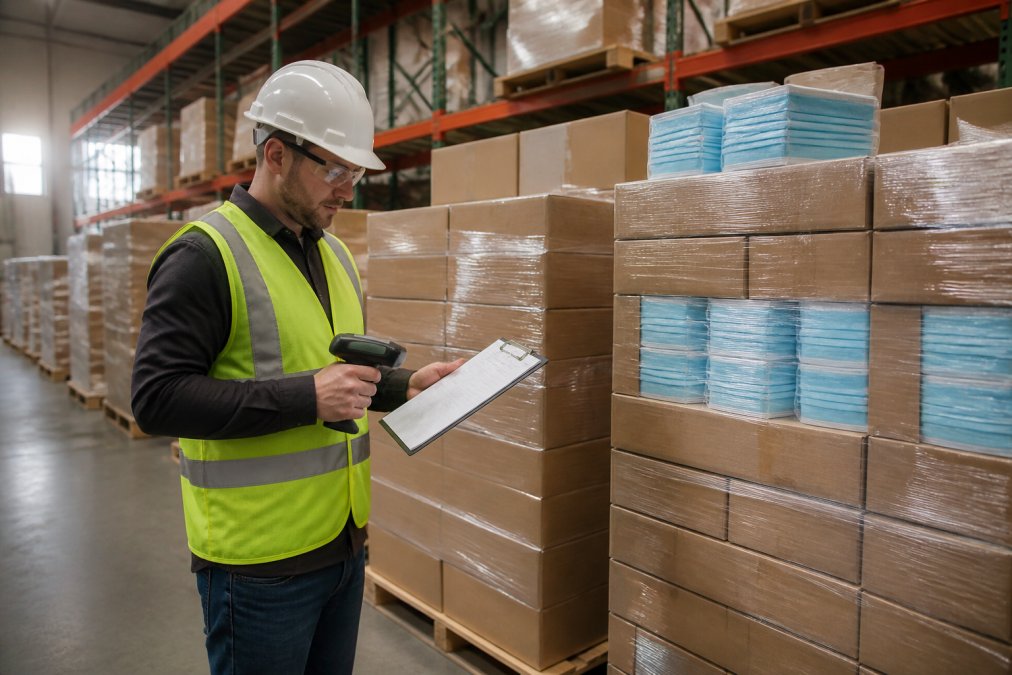
Here is where buyers get tripped up. Imported masks often win on the initial quote. Then freight surcharges arrive. Then a customs delay pushes delivery back three weeks. Then a portion of the shipment fails inspection. Each of those events carries a cost that never appeared on the original invoice.
Disposable Black 3-Layer Face Masks →
| Cost Factor | Imported PPE | Domestically Sourced PPE |
|---|---|---|
| Unit price | Lower at quote | Higher at quote |
| Freight and duties | Variable, exposed to tariff shifts | Predictable, domestic |
| Lead time | Weeks to months | Days to weeks |
| Quality failure risk | Higher without vendor vetting | Lower with documented testing |
| Stockout exposure | High during disruptions | Low with short reorder cycles |
A Total Cost of Ownership Framework for PPE
Unit price is one line in a longer equation. A working TCO model for PPE has five components, and most buyers only track the first:
- Landed unit cost. The quoted price plus freight, duties, brokerage, and any tariff exposure. This is the number that belongs in the comparison, not the quote.
- Carrying cost of safety stock. Inventory held to cover a long lead time ties up working capital and consumes warehouse space. The cost is real even when it does not appear on an invoice.
- Quality failure cost. The expected cost of a failed inspection, a recall, or a workplace safety incident, weighted by the probability your vetting process misses it. Domestic suppliers with documented third-party testing reduce this term.
- Stockout cost. The operational damage of running out. For a food processing line or a hospital unit, this is the largest term in the model and the hardest to estimate, which is exactly why it gets ignored.
- Administrative and compliance cost. Customs paperwork, tariff classification, and the staff time spent chasing shipments.
A practical approach is to score each supplier on all five components rather than comparing unit prices side by side. Most buyers find the domestic premium shrinks once carrying cost, quality failure risk, and stockout exposure are included, and in critical categories it can disappear entirely.
What Consistency Actually Looks Like
Consistency is a measurable property, not a marketing claim. When you evaluate a bulk supplier, ask for:
- Fill rate history. What percentage of ordered units shipped complete, on time, over the past four quarters?
- Peak-season record. How did they handle their busiest month, with specifics rather than adjectives?
- Specification stability. Has the product's material, fit, or packaging changed without notice?
- Reorder lead time. What is the quoted lead time, and what was the actual lead time on the last ten orders?
For organizations running recurring orders, Forbes Medical PPE offers volume pricing and pallet quantities on its individually wrapped 3-layer masks, with case pricing published directly on the product page.
The Environmental Impact of Domestic vs. Overseas PPE Shipping
Freight distance is the single largest environmental variable in PPE sourcing, and most procurement teams never put it on the scorecard.
- Packaging waste. Export crating, moisture barriers, and pallet consolidation for ocean transit generate material that domestic shipments do not require.
- Damaged and discarded inventory. Longer supply chains produce more damaged goods, and replacement shipments are pure waste from an environmental standpoint.
- Obsolescence. Product that sits in transit or in a port queue can expire or fall out of specification before it is ever used.
There is also a resilience argument that overlaps with the environmental one. Shorter supply chains generate less damaged and discarded inventory, and product that arrives intact does not need to be replaced. That is a cost saving and an emissions saving from the same operational change, which is the rare case where the sustainability case and the risk-management case point in the same direction.
Building a Transition Roadmap for Domestic Procurement
Moving to domestic procurement does not require a full supplier swap overnight. A phased transition reduces risk and gives your team time to validate quality before committing volume.
Conclusion
The hardest part of switching to domestic PPE is not finding a supplier. It is justifying the change to a finance team that only sees the unit price on the invoice.
Frequently Asked Questions
What are the primary benefits of sourcing PPE domestically?
Domestically sourced PPE offers shorter lead times, consistent quality control under U.S. manufacturing standards, and reduced exposure to tariff shocks and import duties. It also supports supply chain resilience by keeping production closer to the point of use, which matters for emergency preparedness and operational continuity. For businesses managing a PPE stockpile, domestic sourcing means fewer surprises and faster replenishment when demand spikes.
How does domestic PPE production improve supply chain reliability?
Domestic production shortens the distance between factory and warehouse, cutting transit time from weeks to days. That reduces the risk of port congestion, customs delays, and geopolitical disruptions that affect overseas shipments. A domestic supplier can also scale production faster during demand surges, which is critical for healthcare infrastructure and industrial operations that cannot afford stockouts.
What are the risks of relying on overseas PPE suppliers?
Overseas suppliers introduce risks including longer lead times, exposure to tariff shocks and trade policy changes, quality variability, and the possibility of counterfeit products entering the market. When a single overseas factory faces disruption, the entire supply chain stalls. Domestic procurement eliminates many of these variables, giving procurement managers more control over inventory management and vendor vetting.
How do domestic PPE standards ensure higher quality control?
Domestic manufacturers follow U.S. quality assurance frameworks and can be held accountable to ASTM standards for mask performance. Third-party testing and certifications are easier to verify when the factory is nearby. This transparency matters for regulatory compliance, especially in healthcare and food processing settings where documentation is required for audits and safety inspections.