
Last Updated: October 26, 2026
Quick Summary
Mask hygiene is the practice of keeping a face mask clean, dry, correctly worn, and replaced on schedule so it does not spread bacteria or microorganisms to food, surfaces, or other workers. Change disposable masks when damp, soiled, or damaged, and at minimum once per shift in most food plant conditions.
- Wash hands before donning a mask and after removing one.
- Don gloves last when gearing up, and remove them first when gearing down.
- Remove masks by the ear loops only, never the front.
- Disposable masks are one use only: no pockets, lockers, or hanging from an ear loop.
- Supervisors should spot-check mask fit and condition at line start.
Table of Contents
- Why Mask Hygiene Matters on the Production Line
- Food Handler Personal Hygiene: Where Masks Fit In
- How Often to Change a Face Mask on a Shift
- Proper PPE Donning and Doffing for Food Production
- Mask Storage and Handling Between Uses
- Matching Mask Fit and Type to Each Production Zone
- Training, Compliance Checks, and Corrective Actions
- Stocking Your Facility with Individually Wrapped Masks
- Frequently Asked Questions
Why Mask Hygiene Matters on the Production Line
A face mask only protects the food supply when it stays clean.
Here is the core problem. A mask traps droplets and particles on both sides. The outer surface collects whatever is in the air.
That definition matters because food plants already manage handwashing, gloves, and smocks closely. Masks deserve the same discipline.
Below, we walk through the seven rules that keep masks from working against you.
Food Handler Personal Hygiene: Where Masks Fit In
Masks are one layer of a larger system.
Start with handwashing. Workers should wash hands before donning a mask and after removing one.
Then look at the full set of controls:
- Clean hands and trimmed nails
- A smock or apron over street clothes
- Hair restraints that keep hair out of product
- Gloves changed at the right moments
- A mask worn over the nose and mouth, not under the chin
A common mistake is treating the mask as a substitute for distance and hand hygiene. It is not. The mask reduces what leaves the wearer's mouth and nose.
The FDA Food Code treats employee health and hygiene as a core control for foodborne illness prevention. Masks sit inside that framework, not outside it.
How Often to Change a Face Mask on a Shift
Change a disposable mask when it becomes damp, soiled, or damaged, and at minimum once per shift in most food plant conditions.
There is no single clock that fits every line. The right answer depends on the environment. Here is how we would set the schedule:
- Dry, light-duty areas: change at mid-shift and again if the mask gets wet or dirty.
- Cold or humid rooms: change whenever the mask feels damp, which may be every few hours.
- Heavy-exertion or hot areas: change more often, since sweat and breath moisture build fast.
- After any contamination event: change immediately if the mask is dropped, touched by a bare hand, or splashed.
A damp mask loses its shape and its filtering behavior. It also feels uncomfortable, which pushes workers to touch and adjust it. Both problems raise contamination risk.
Watch out: the most common failure is a worker who keeps the same mask from clock-in to clock-out because changes feel inconvenient. Fix the supply and the access, and the behavior follows.
Change frequency depends on the conditions in each area of the plant.
| Area or situation | When to change |
|---|---|
| Dry, light-duty areas | At mid-shift, and again if wet or dirty |
| Cold or humid rooms | Whenever the mask feels damp, possibly every few hours |
| Heavy-exertion or hot areas | More often, as sweat and breath moisture build fast |
| After any contamination event | Immediately if dropped, touched by bare hand, or splashed |
Proper PPE Donning and Doffing for Food Production
Proper PPE donning and doffing is the order of putting gear on and taking it off. Do it in the right sequence and you keep contamination off your skin, your clothes, and the food.
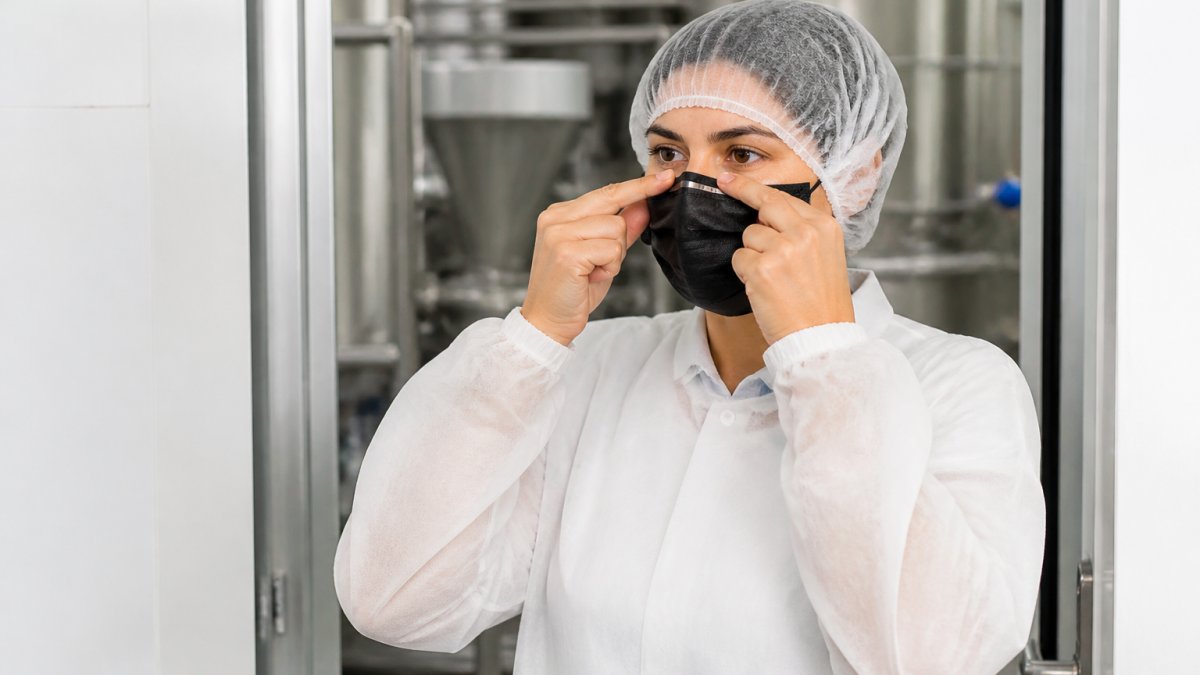
Put gear on in this order:
- Wash hands thoroughly.
- Put on the hair restraint.
- Put on the smock or apron.
- Put on the mask, pressing the nose wire to fit.
- Put on gloves last, so you do not contaminate them while adjusting other gear.
Take gear off in reverse, and treat the mask as contaminated:
- Remove gloves first and wash hands.
- Remove the smock without touching the outside.
- Remove the mask by the ear loops only, never the front.
- Discard the mask into a closed bin.
- Wash hands again.
The CDC guidance on PPE removal stresses handling the front of a mask as contaminated. That single habit prevents most mask-related cross-contamination in a plant.
Mask Storage and Handling Between Uses
Mask storage and handling decides whether a mask is still clean when a worker puts it back on. For disposable masks, the rule is simple: one use, then discard.
A practical handling procedure for a food-production floor looks like this:
- Before donning: wash hands, then open a fresh individually wrapped mask or take one from a clean dispenser. Do not dig through a loose bin.
- While wearing: touch only the ear loops or edges when adjusting. If the mask must come off briefly, remove it by the loops and hold it away from the body and from food-contact surfaces.
- At break: discard the disposable mask into a closed bin before eating or drinking. Do not park it on a table, a prep surface, or a smock pocket.
- After break: don a fresh mask with clean hands.
- At end of shift: remove by the ear loops, discard into a closed bin, and wash hands.
For reusable cloth masks, the storage rules are stricter because the mask is worn again.
Black 3-Ply Face Masks Individually Wrapped and Disposable 200 per Case →
Replacement schedules should be written into the plant's sanitation routine, not left to worker judgment. A common pattern is a fresh mask at the start of each shift, a second mask available at mid-shift, and an immediate change after any contamination event: dropped mask, bare-hand touch of the front, splash, or visible soil. Supervisors should be able to point to where fresh masks are stocked at every line entrance and break-room exit.
Disposal matters too. Closed bins near exits and break areas keep used masks out of production areas, and bins should be emptied on the same schedule as other sanitary waste.
For facilities that want a hygienic option, individually wrapped disposable masks solve the storage problem before it starts. Our individually wrapped black 3-ply face masks come 200 to a case and are built for exactly this kind of plant use.

Matching Mask Fit and Type to Each Production Zone
Fit and type should follow the zone and the task. A mask that gaps at the sides lets breath escape around the edges, which defeats the purpose. A mask that fits well and suits the task does the job.
Start with a simple zone assessment. Walk the floor and note, for each area, whether exposed food is present, how cold or humid the room runs, how much physical exertion the task requires, and whether visitors pass through.
Fit check (do this every time a mask is donned):
- Cup the mask over the nose and mouth so the top edge sits on the bridge of the nose.
- Press the nose wire to match the shape of the face.
- Check that the edges sit flat against the skin with no visible gap at the sides or under the chin.
- Turn the head side to side and speak a sentence. If air leaks at the edges or the mask shifts, reseat it or try a different style.
Matching mask to zone:
- Dry packaging and warehouse zones: a standard 3-layer disposable mask works well. Breathability matters more than filtration here because exertion is low and the mask is worn for long stretches.
- Cold and humid processing rooms: choose a mask that holds its shape when damp and plan for more frequent changes. Moisture is the main enemy in these rooms; a mask that collapses when wet loses its seal and invites touching.
- High-exertion areas: prioritize comfort, a secure nose wire, and ear loops that do not slip. A mask that stays put is a mask workers stop adjusting.
- Exposed-food and ready-to-eat areas: treat mask fit as a critical control. A gap at the side is a direct path from the wearer to product, so fit checks belong at line start, not just at onboarding.
- Guest and visitor areas: individually wrapped masks give a clean mask on demand and avoid a shared bin at the entrance.
A common mistake is buying one mask type for the whole plant. Zones differ, and so should the supply.
Black masks also suit front-of-house and visitor use, where a clean look matters. Our masks are not intended for medical use; they are breathing barriers for plant and workplace use, and selection should be based on fit, comfort, and task suitability.
Training, Compliance Checks, and Corrective Actions
Training turns rules into habits. Workers need to know when to change a mask, how to handle it, and why it matters. A short session at onboarding plus a refresher each quarter covers the basics.
Build compliance checks into the daily routine:
- Supervisors spot-check mask fit and condition at line start.
- Any worker with a damp, soiled, or damaged mask changes it on the spot.
- Mask handling is part of the plant sanitation walk-through.
- Findings get logged, and repeat issues trigger retraining.
Corrective actions should be simple and fast. If workers keep pulling masks down to talk, add a reminder at the line. If masks run out mid-shift, fix the supply.
The USDA Food Safety and Inspection Service frames employee hygiene as part of a plant's overall food safety system. Mask checks belong in that same system, alongside handwashing and sanitation logs.
Stocking Your Facility with Individually Wrapped Masks
Individually wrapped masks remove the biggest handling risk in a plant: the shared bin.
For high-volume facilities, the supply chain matters as much as the product.
At Forbes Medical PPE, we make our masks in Peoria, Illinois, with domestically sourced materials and volume pricing for pallet quantities.
If you want to see the product and order for your facility, you can browse the individually wrapped black 3-ply masks and check case quantities.
Keeping mask hygiene consistent across a 200-person plant is a supply problem as much as a training problem.
Frequently Asked Questions
Should food production workers wear masks?
Masks are a recognized part of personal hygiene in food production because they block droplets from the nose and mouth that can carry bacteria onto product, equipment, and surfaces. The FDA's Food Code treats contamination from food handlers as a preventable hazard, and GMP and HACCP programs typically address it. A mask only helps when it is worn correctly, kept clean, and changed on schedule. A damp, soiled, or reused mask becomes a contamination risk itself.
How often should food production workers change their masks?
Change a disposable mask when it becomes damp, soiled, torn, or hard to breathe through, and at a minimum at set intervals during the shift, such as every four hours or at each break. High-humidity rooms and heavy physical work shorten wear time. Reusable masks need washing after every shift. Post the schedule at the entrance and at break areas so workers know exactly when to swap, and stock replacements within reach so no one stretches a mask past its limit.
How should masks be stored in a food production facility?
Keep unused masks in their individual wrappers until the moment of use, stored in a clean, dry area away from production surfaces and chemicals. Never rest a mask on a work table, on equipment, or under a chin. Once a mask is removed, it should be discarded or, for reusable types, placed in a designated container for washing. Storing masks in pockets, aprons, or on shelves above open product risks transferring contamination.
What should workers do if a mask becomes wet or contaminated?
Leave the production area, wash hands, remove the mask by the ear loops without touching the outer surface, and discard it in a closed bin. Put on a fresh, individually wrapped mask, check the fit, wash hands again, and return to the line. Report the event so it can be logged as part of your sanitation records. A wet mask loses its barrier function and should never be dried and reused.
