
Table of Contents
- Why Domestic PPE Supply Chain Verification Matters
- Step 1: Run a PPE Supplier Verification Checklist
- Step 2: How to Verify PPE Country of Origin
- Step 3: FDA-Cleared Mask Verification and Certificate Checks
- Step 4: Spot Counterfeit PPE Warning Signs Before You Buy
- Step 5: Trace Product from Manufacturer to Delivery
- Step 6: Build Ongoing Domestic PPE Supply Chain Monitoring
- Frequently Asked Questions
Last Updated: October 17, 2026
Why Domestic PPE Supply Chain Verification Matters
At Forbes Medical PPE, we make our masks in Peoria, Illinois, so we sit on the manufacturing side of this question.
"Made in USA" is a marketing claim until someone asks for the paperwork behind it, and most procurement teams never ask.
This guide closes that gap with six verification steps, from a supplier checklist to lot-level traceability, each runnable this week.
Step 1: Run a PPE Supplier Verification Checklist
A PPE supplier verification checklist is a fixed set of questions asked of every vendor before the first purchase order, scored the same way each time, so you compare suppliers on evidence rather than sales confidence.
Run these checks in order:
- Legal business name, address, and registration confirmed
- Manufacturing location stated in writing, not just implied
- Product documentation available on request
- Named contact who can answer technical questions
Score each item pass or fail. Two or more fails means you keep looking.
The most common mistake is treating a smooth website as proof of a real factory. Ask for the address where the product is made, then check it against the business registration.
Step 2: How to Verify PPE Country of Origin
To verify PPE country of origin, reconcile a chain of records rather than reading a label.
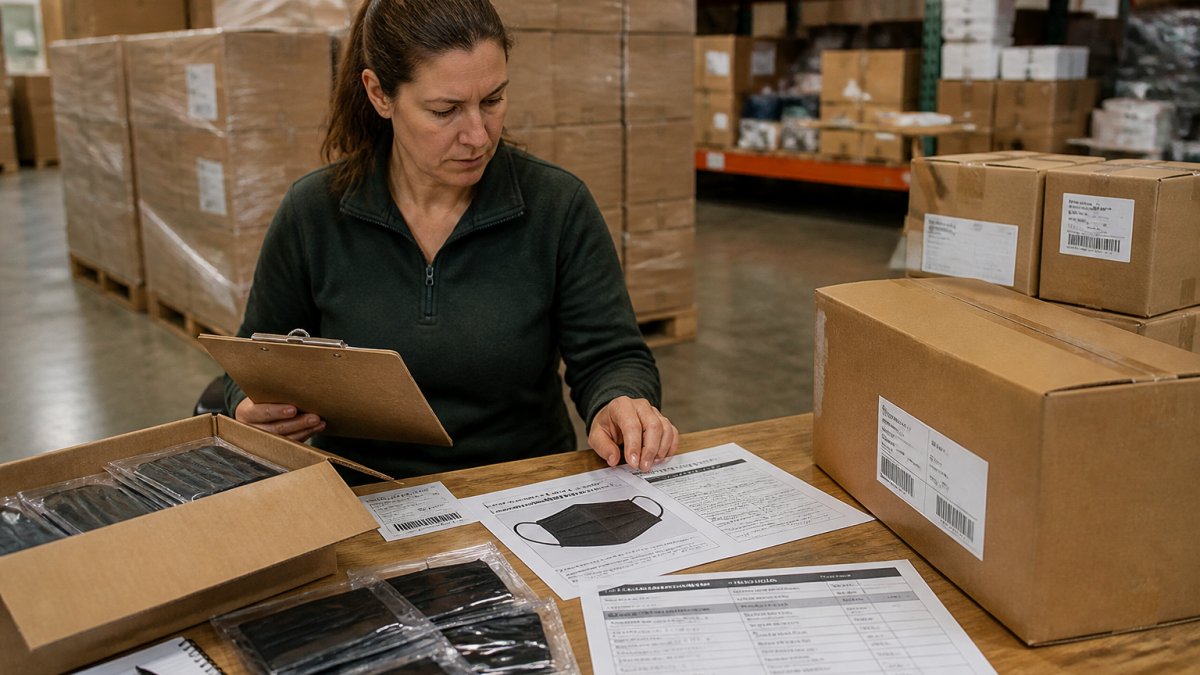
Start by requesting the full document set in writing. A supplier making a genuine domestic claim should be able to produce all of the following without delay:
- Commercial invoice and packing list for the shipment
- Manufacturer's written statement of the production site, including the street address
- Bill of materials or component sourcing summary for the finished product
- Lot or batch records tying the delivered carton to a production run
- Business registration or facility documentation for the named manufacturing address
Country-of-origin marking on imported goods is enforced by U.S. Customs and Border Protection, and that marking must be legible and permanent.
Most buyers stop at matching the label to the invoice, which only proves the paperwork agrees with itself. To confirm domestic manufacture, work through these checks:
- Name the factory, not the brand. Ask for the legal name and street address of the facility where the product was assembled. A brand name, a P.O. box, or a distribution center address is not a manufacturing site.
- Match the address to a real facility. Cross-check the address against the business registration and, where available, state or local business filings. A factory address that resolves to a self-storage unit or a residential mailbox is a stop sign.
- Separate assembly from distribution. A product can be assembled domestically from imported components, or imported finished and repackaged domestically. Ask which one applies and get it in writing. "Made in USA" claims carry specific expectations, and a supplier should be able to state plainly whether the product is assembled here from domestic and imported parts or manufactured here end to end.
- Reconcile the bill of materials. For masks and gowns, ask where the critical inputs, meltblown fabric, nonwoven layers, elastic, nose wire, were sourced. Domestic assembly of imported fabric is common and legal, but it is not the same as a domestic supply chain, and buyers should know which they are getting.
- Tie the lot to the site. The lot or batch number on the carton should connect to a production date and a named facility. If the supplier cannot make that connection, the domestic claim is unproven.
Watch for these mismatches:
- Label says one country, invoice says another
- Origin listed as a region or trade bloc rather than a country
- "Assembled in" used where "made in" is claimed
- "Distributed by" or "Packaged by" presented as manufacturing
- Documents that arrive as screenshots rather than originals
A supplier who cannot produce clean, consistent origin records on request is telling you something. A domestic claim that cannot survive a document-by-document comparison is a distribution claim wearing a manufacturing label.
Step 3: FDA-Cleared Mask Verification and Certificate Checks
FDA-cleared mask verification means checking the product against the FDA's own public database, not a certificate PDF a supplier emailed you, certificates are easy to alter, database listings are not. Here is a repeatable method for validating both.
Here is the accuracy point that trips up most buyers: the FDA clears masks, it does not certify them. Anyone who says their mask is "FDA certified" is using the wrong word, and that alone is a reason to look closer.
Validate the regulatory listing first
- Ask for the product's FDA 510(k) number if it is a medical device.
- Look the number up in the FDA's public device database.
- Confirm the listed manufacturer name matches your supplier, not just the brand name on the box.
- Confirm the product description and model match what you are buying.
- Note the clearance date and check that the listing has not been rescinded or updated since.
If the supplier cannot give you a 510(k) number, ask what the product's actual regulatory status is: cleared, registered, or non-medical. A supplier who answers that precisely is usually a supplier worth keeping.
Validate the certificate itself
A certificate is only as good as its issuer. Run these checks every time a document arrives:
- Issuer. Identify the lab or body that issued the certificate. Confirm it exists and that the scope of its accreditation covers the test being claimed. A lab you cannot find is a certificate you cannot use.
- Scope. Read what was actually tested. A certificate for a fabric or component is not a certificate for the finished mask. Confirm the certificate covers the finished product and the specific model you are buying.
- Model and part numbers. Match the model number on the certificate to the model number on the carton and the invoice. A certificate for a different model proves nothing about the product in front of you.
- Validity dates. Check the issue date and expiration date. An expired certificate is not evidence of current compliance, and a certificate with no date is not evidence of anything.
- Version control. Ask for the current revision. Suppliers sometimes send an older certificate that was superseded after a formulation or process change.
Know what the product is actually rated for
A barrier-style mask sold for non-medical use is not required to be ASTM tested or certified, that is normal and legal. Our own black 3-ply mask uses the same ASTM-certified meltblown material as our medical line, but the finished mask is not FDA cleared and carries no ASTM rating because it has not been tested as a whole.

So ask not "is it certified?" but "what is this product actually cleared or rated for, and does that match my use case?" A non-medical barrier mask can suit general use while carrying no FDA clearance and no ASTM rating. Verification confirms the claim matches the product; it does not demand a certification the category does not require.
Black 3-Ply Face Masks Individually Wrapped and Disposable 200 per Case →
Step 4: Spot Counterfeit PPE Warning Signs Before You Buy
Counterfeit PPE warning signs show up in the details: pricing far below market, packaging typos, missing lot numbers, and suppliers who dodge documentation requests.
The pricing signal is most often ignored: if a quote undercuts every other domestic quote by a wide margin, either the product is not domestic or the documentation is not real.
Other signs worth checking:
- Generic packaging with no manufacturer name or address
- Labels printed on stickers applied over other labels
- No lot or batch number anywhere on the carton
- Certificates that name a lab you cannot find
- A supplier who will not name the factory
Procurement fraud in PPE rarely looks dramatic. It looks like a slightly cheaper carton with slightly vaguer paperwork.
Step 5: Trace Product from Manufacturer to Delivery
Traceability means following a specific lot from the production line to your loading dock, the strongest single check available, because it is hard to fake at scale.
Ask your supplier for the lot number on the carton you received, then to connect it to a production date and site.
Build a simple record for each delivery:
| Record | What to Capture | Why It Matters |
|---|---|---|
| Lot number | Printed on carton and inner packaging | Ties product to a production run |
| Production site | Named facility and address | Confirms domestic manufacture |
| Ship date | Date on packing list | Supports chain of custody |
| Receiving check | Condition and label match | Catches substitution early |
Keep these records for every order, not just the first. Chain-of-custody controls only work if they are continuous.
For volume buyers, ask whether the supplier can hold lot numbers consistent across a recurring order.
Step 6: Build Ongoing Domestic PPE Supply Chain Monitoring
Ongoing monitoring is a light, repeating routine: re-check suppliers on a fixed schedule instead of trusting a one-time approval.
A practical cadence:
- Quarterly: confirm the manufacturing site has not changed
- Quarterly: spot-check one delivery against its lot records
- Twice a year: re-verify regulatory listings
- Annually: re-run the full supplier checklist
- Always: log any packaging or labeling change
Pair this with a response plan for suspected counterfeits: quarantine the lot, document findings, notify the supplier in writing, and report to the appropriate authority.
For buyers who want a simpler path, working directly with a domestic manufacturer removes most of these layers. Our Black 3-Ply Face Masks are made in partnership with Peoria Production Solutions in Peoria, Illinois, individually wrapped, and sold in 200-count cases.
Forbes Medical PPE makes that verification simpler because the manufacturing site is known, the materials are documented, and volume orders ship from a domestic line.
Get started with Forbes Medical PPE and source protective equipment you can actually trace.
Frequently Asked Questions
What documents should a PPE supplier provide to prove domestic manufacturing?
Ask for the manufacturer's name and address, product labeling and packaging samples, lot or batch records, and any test reports tied to the specific lot you are buying. A supplier should be able to show a clear link between the factory that made the product and the shipment in front of you. If the documentation names a different company than the one on the invoice, ask why before you order. Keep copies of everything so your records match what was delivered.
How do you verify a mask's FDA clearance?
The FDA clears devices, it does not certify them, so treat any 'FDA certified' claim as a red flag. For a mask marketed for medical use, ask for the 510(k) clearance number and check it in the FDA's public device database. Confirm the product name, manufacturer, and intended use match what you are buying. Non-medical barrier masks are not FDA cleared at all, so a seller claiming clearance for a general-purpose mask is misrepresenting the product.
How can buyers trace PPE from manufacturer to delivery?
Match lot numbers on the packaging to the batch records the supplier provides, then compare those records to the shipping documents for your order. Photograph pallet labels and carton markings when the shipment arrives. If the lot number on the box does not appear in the supplier's records, or the shipping paperwork lists a different origin than the product label, pause and ask for an explanation in writing before distributing the product.
What are common counterfeit PPE warning signs?
Watch for prices far below the market, missing or mismatched lot numbers, packaging with blurry printing or spelling errors, and certificates that cannot be checked against a public listing. Sellers who refuse to name the manufacturer or dodge questions about the factory are another warning sign. A legitimate domestic supplier will answer direct questions about where the product was made and provide documentation that ties the shipment to that facility.